
Unmarked Raves
Chasing status through intoxication

I am peripherally aware - in the sense that I know of but have not looked directly at - a strand of film and television set around luxury resorts, wellness retreats, yachts and private islands where often drugs are taken in the name of insight as much as intoxication, and intrigue ensues. A kind of Agatha Crusty mystery, if you like. The White Lotus, Nine Perfect Strangers, Knives Out, and so on. I am not being sniffy here with the whole peripheral awareness thing, I just haven’t – unlike the subjects of the stories - had time lately to indulge. I am sure they are fun and equally certain that just as Agatha knew there was evil under the sun there is little truly new beneath it either.
Newness however, innovation real, imagined and hallucinated, would seem to be a profound complication among the IRL jet set whose antics are being referenced here. With some inevitability, there are, among the sun loungers and upon the raked, white sands, those convinced that alongside the apps and inventions which have underwritten the party they have also, whilst tripping with some models, seized the source code for existence.
Not for the first time Precise Instructions must tip its hat to the work of Jules Evan’s Ecstatic Integration, whose interview with Antoine Sepulchre, a former facilitator of meaningful experiences for those beyond budgetary constraints, is in some ways as mind-blowing as anything it describes. One thinks one can imagine these things, I have even witnessed some, but it is the detail that gets you, and I am assuming (and if you have seen the aforementioned shows, then do let me know) that truth has the edge on fiction here.
One that leaps out is:
“the founder of one of the world’s most iconic brands, which he sold for over a billion dollars. He now smokes Bufo daily mixed with pure cocaine. And he’s started dressing up like a frog and his house is completely decorated with frogs…He lost tens of millions on his latest venture also trying to elevate the world consciousness.”
Bufo - in case it has not yet cropped up in the toilets at your local – is toad venom containing the hallucinogen DMT. Said to offer God-like experiences for its users, its acquisition is less fun for the toads.
Whilst much of what we consume and cherish comes at the expense of the natural world and deification could be argued to trump a bacon sandwich in terms of yield-to-suffering, it is as well to keep the idea of an amphibian underclass in mind here since inequality is a theme.
While Mr Sepulchre speaks of self-anointed shaman types vying for the attention of clients, “worth around $140 billion” and a “doctor in Ibiza who gets his “patients” on an explosive 6 hours deep dive introspective trip including magic mushrooms, MDMA and ketamine IV,” this tendency to package experiences once accessible and even mundane as exclusive is well established.
There was explosion of online schadenfreude audible from Somerset to Strathclyde this week as it emerged that a firm selling Glastonbury Festival packages for around £10,000 a pop had itself gone bust and left those who deemed this a good use of their lucre without a yurt to piss in.
Glastonbury Festival yurt glampers ticketless as Yurtel goes bust - BBC News
I am not suggesting that those featured in or affected by the story were planning to take drugs. The through line, it seems to me, is that these ‘experiences,’ priced and positioned as spectacular were once within the remit of anyone who happened to be interested, regardless of income, and that by extension, the curated revelations of the billionaires have all been had already, and less on private islands than under pylons, in shop doorways and on sticky kitchen floors.
One of the defining gifts of my particular timeline was coming of age in the UK under the auspices of, ‘Acid House.’ By this I mean the social-cultural movement nascent from approximately 1988 to 1992 and characterized - in part - by electronic music and hallucinogenic drugs. The nature of the highs and the frequency of the music are less the point here than the accessibility. If you were interested, there it was. Barriers to entry were physical rather than financial and the odds were someone else had found a way into the field or former factory hours before you stepped over the threshold, or somehow persuaded the owner of the nondescript nightclub to put some of that strange new music on.
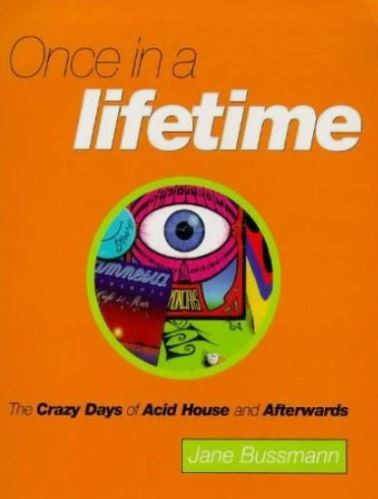
The sacred text of that era IMO is Jane Bussman’s Once in a Lifetime, a glorious oral history of the wide-eyed, seldom less than £25 second hand but happily available on Audible for less and read by the author.
Its testimony makes the point that such wisdom as might be found at the end of a long night has long been available, whether in 1988, ’68 or far before and beyond, and that many of those who have glimpsed it went quietly about or simply amended their business – rather than perceiving themselves at the upper reaches of a trickle down pyramid of elite insight with a monetised scheme for awakening the rest of us.
The glitch in the modern matrix, the urine in the infinity pool, is the idea that those in a position of real power are coming to believe they are the heirs to insights which have always been accompanied, right down to their mythic roots, with warnings about hubris. Prometheus’ stealing fire from the Gods is a much-beloved and I suspect much misunderstood narrative in tech circles. On the one hand it is a cry for humans to take all that can be had from the universe in the name of our own enlightenment. It bears pointing out, however, that the name Prometheus can be read in ancient Greek as meaning “foresight,” but also as, “too soon,” or “without looking.” Getting the camel through the eye of the needle is not an inconsequential metaphor considering what some at the corner of Ketamine and wealth are endeavouring to do.
Antoine Sepulchre appears, after some statutory reversals, “From flying in private jets, I ended up living in my car,” to have hit upon something vital:
“The problem isn’t the belief in one's importance, it’s the lack of belief in everyone else’s.”
Well said. We should hope he is able to ply the truth of his learning to those gilded ears as will listen.
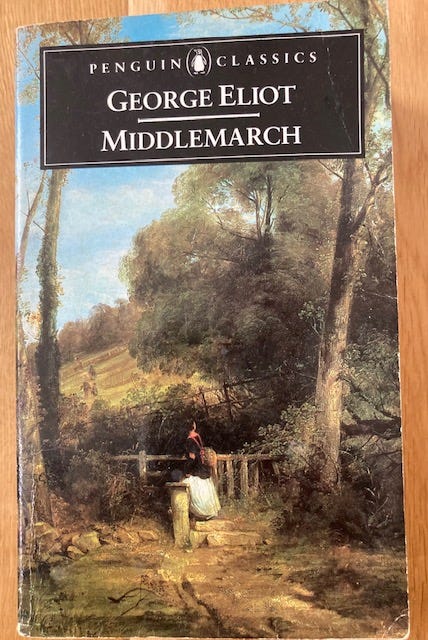
In 1990 I calmed down for long enough to remember that was a student of literature as well as self-indulgence and tore through George Eliot’s 1871 novel Middlemarch in a panic ahead of an exam. I was rewarded throughout but also with its legendary conclusion which I offer here I hope not as a spoiler but as an incentive to read real books, in real time, and through them learn of what is timeless, free-to-all and also to make it clear that opening pun about unmarked raves was heading somewhere:
“..for the growing good of the world is partly dependent on unhistoric acts; and that things are not so ill with you and me as they might have been, is half owing to the number who lived faithfully a hidden life, and rest in unvisited tombs.”
That plea for real reading was not from nowhere, this story about AI book recomendations in what is left of the newspaper business might be galling if it weren’t so predicatable: www.nbcnews.com/tech/tech-news/chicago-sun-admits-summer-book-guide-included-fake-ai-generated-titles-rcna208325
Meanwhile the piece behind my piece is here for you too:
