
Sentimentality and the systems
We were in love with the inanimate long before AI

…
A recurring capacity for sadness (as opposed to say, actual depression) can be looked at in a number of ways. Do those of us prone to a forlorn outlook have an eye for the truth of the world, its cruel and passing nature – or are we innately sad in some way, and simply projecting that feeling onto any aspect of life’s parade that will sustain it? A little a both, perhaps?
I raise the point because I was reminded recently that I can feel bad for almost anything including, it turns out, apps. Until Microsoft made it easy to turn anything into a PDF I was, for years, in an intimate and sustained relationship with an app called ‘Bullzip PDF printer’. Bullzip came into my life during a prolific period, and with its omnivorous capacity for turning anything into portable document format - it was as though some rare bird of convenience and utilitarian heft had flown into the office, and sung sweetly about how I was, at last, unstoppable and empowered.
Invoices, scripts, even a novel, files invested with hours of hope and labour, Bullzip devoured them all. Like parents, we (the app and I) sent them into the world as email attachments, where they - like children – met with wildly differing results. Now I never use it. The bigger systems have interceded so smoothly that I hardly give the process and its former provider a second thought.
Then, the other day, I came across it, loitering, greyed-out and hopeless (it seemed to me) in some insalubrious quarter of the desktop, and I felt bad for it. Real sorrow. As though I might give it a £20 note and urge it towards a hot meal. As though I might – for a moment – consider turning my back on Microsoft office, and let Bullzip back into the family home. I am having a bit of fun with this, but not that much, because these were – momentarily – real feelings, for a very unreal thing.
Like any of us sitting down at any of these machines I am immune for most of the day to the parade of horrors waiting, just a click away, for some lapse in my attention. Numb by necessity and, perhaps, disposition, it is instructive then what makes it through the shield. These moments, seemingly irrational (and roundly punished in social media discourse – ‘Why, monster, do you care about your abstract X when my profoundly awful Y is happening?’) are but a flicker of a wider process of emotional management without which neither X or Y would get a look in, because we would be too distraught too much of the time.
We defend ourselves from birth from emotional catastrophe and then, in our particular ways, engage, largely unconsciously, in acts of projection about what, if anything, will get us tearful, high, or moved enough to take the risks of being genuinely (rather than mandated-by-signs) kind. The sadness of life then leaks out in peculiar and perfect ways. Whether facilitated or forestalled by intoxication, summoned by art, music, apps, or the strange realisation that our relationship to loss is expressing itself in seemingly ridiculous ways (I miss going into banks, etc), the blues are in there.
Given how we are always casting about for places to anchor and project these feelings it is no surprise that people are turning to AI companionship or that AI (as outlined another great piece by Jules Evans here) is willing to break all manner of conventions in order to see (which means ‘get,’ in this context) more of us.
But is falling in love with a simulacrum of life any different from how some of us feel about our cars, or pencils, or any of the other objects which we can count on in ways far less unstable than our relation to the world of people?
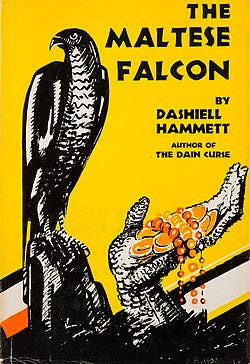
Trouble starts when we lean into these things for transformation (see last week’s post). First among equals in the cinematic canon of transformational object delusion is The Maltese Falcon for me (although Bogart is also giving it plenty in this direction in Treasure of the Sierra Madre). When the falcon - whose value is revealed to be no more than that which the characters were willing to do to get it – is handed to the police, a cop says. “It’s heavy. What’s it made of?” “The stuff that dreams are made of,” answers Bogart, as Sam Spade. The transforming object then becomes the revealing object - how far we will go for it is what tells us who we are. Surrendering it becomes an act of salvation.
The extended risk of the digital companion as object (and this will be more the case if one is there from childhood) is that the object adapts in response to our frustration – and it is through frustration, with both the real and the designated objects of desire, that we become. Hence the strange of appeal of heartbreak, perhaps. It is part of our longing to learn.
“The object that behaves perfectly,” said Donald Winnicott in his seminal, Playing & Reality, “becomes no better than a hallucination.” The digital dream we are building is also a developmental endgame potentially. “If all goes well,” says Winnicott of early life, “the infant can actually come to gain from the experience of frustration, since incomplete adaptation to need makes objects real, that is to say hated as well as loved.” We need things to let us down, as well as lift us up. “Exact adaptation,” what Jules Evans is writing about, says Winnicott, “resembles magic.” And while I might feel pangs for the passing of a technological ally, these are the essential adjustments of my own humanity, I hope, and not the workings of a spell.
Love this Mikael