
Our Mother the Mountain
Greed, growing older and getting down with the uphill struggle.

They say a change is as good as a rest, but there are certain alterations that can take the wind right out of your sails. My doctor’s surgery has relocated from a series of ageing Portakabins to a pristine, permanent facility across the road, and I am not OK with what this says about neglect. I like a temporary structure because I am increasingly aware that I am one. I was partly schooled in Portakabins, and healed in Victorian hospitals - for all their efficacy, modern buildings selling healthcare feel, to me, like a subtle, ‘f*ck you’.
I was in reception waiting my turn when a man entered who struck me as someone with youth squarely behind them. He had a fulsome beard, for religious reasons, I think – but I was staggered when the receptionist asked him for his date of birth and he announced that he had emerged from his mother in this young century, and was aged just 23.
The disparity here is less between what one sees and what is real but between the self who looks out on the world and what the outside world sees when it looks in. It’s not that I think the man is older than he is - but that my ‘self,’ the viewer, feels like an ageless thing. So, when evidence arrives that I am not; in the form of 23-year-old adults, shiny new buildings, or the subsequent, statutory lecture I received about units of alcohol, cholesterol and blood pressure - the question I am left with is less about whether I should send lager and butter away like I did with cigarettes, but about what kind of old man I want to be.
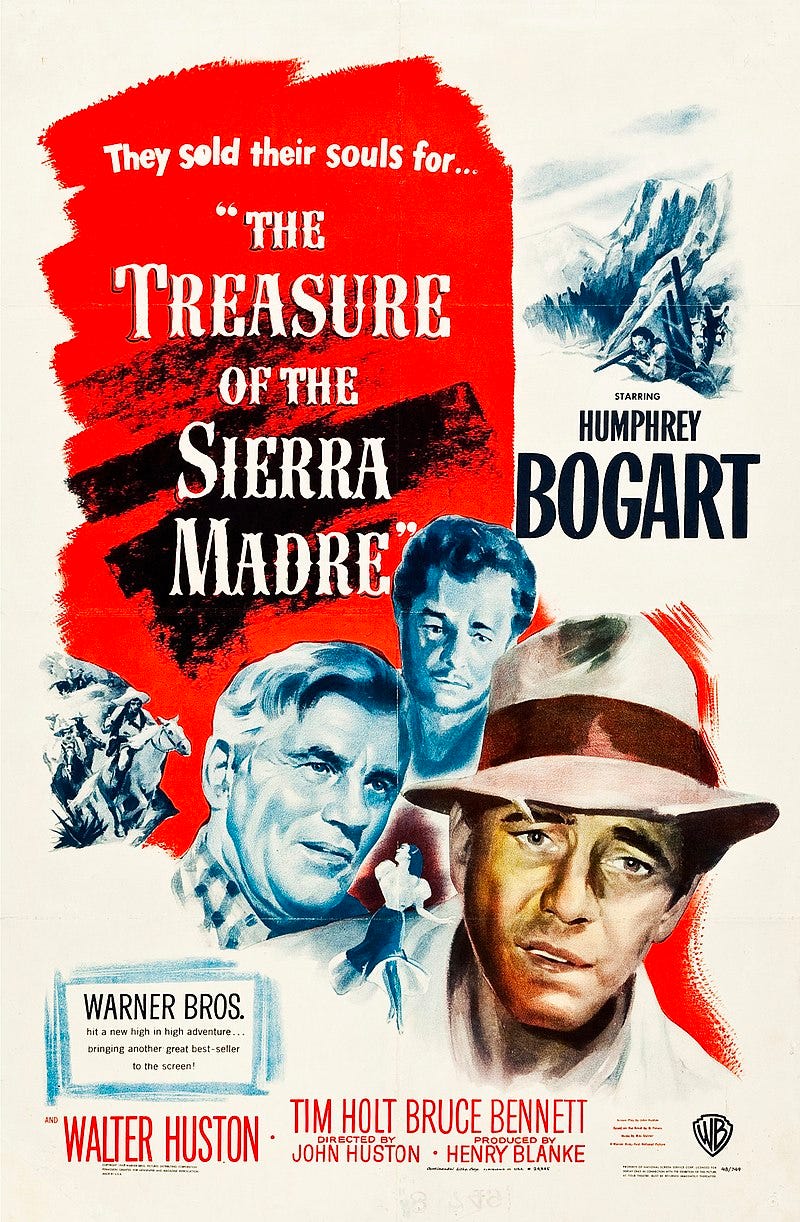
Like buildings, we need a blueprint sometimes. My model for old manhood is suitably seasoned, Howard the prospector, played by Walter Huston in, The Treasure of the Sierra Madre. No one quite knows when Walter Huston was born but he was around 63 when the movie was shot in 1947 and died three years later aged, at most, 67, none of which is ‘old’ by modern standards.
It is less the specifics of Huston’s age that matter but the spirit of his character and that of his performance – reflected on here by his granddaughter, Angelica.
“The best old prospector you could hope to meet,” is a nice way to be remembered. The film, if you don’t know, concerns the search for gold, and one of many appealing things about the character of Howard is that he is not only able to wax lyrical about the dangers of sudden wealth but open about his own, fated attraction to it – a degree of self-awareness which might be part of what enables him to dance a fine line between fate and fatality.
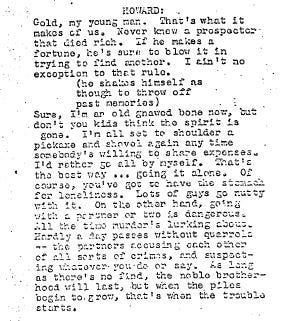
“Never knew a prospector that died rich. If he makes a fortune he’s sure to blow it in trying to find another. I ain’t no exception to that rule.
(he shakes himself as though to throw off past memories)
Sure, I’m a gnawed old bone now, but don’t you kids think the spirit is gone.”
I say dance a fine line because no-one who has seen the film is likely to forget Walter’s ‘gold’ dance, described in the script as, ‘a goatish kind of jig.’. Often parodied, never bettered and, significantly, a reaction to Humphrey Bogart’s threat to kill him.
As Angelica Huston points out, Howard is the moral centre of a moral picture. The Treasure of the Sierra Madre is often summed up as a parable about wealth but it is more subtle than that. Dobbs, Curtin, Howard and the other characters are a calibrated spectrum of ways in which individuals, groups, cultures and eras both are and are not fatally beguiled. As one of the comments there on YouTube notes – “Gold doesn't change a man's character, it reveals it.”
Dobb’s descent into gold psychosis is not just wonderfully portrayed by Bogart but seeded throughout. There is something restive in him from the outset (again, the performance is doing some of the work here), he cannot bear an insult, he is the first to give up and the first to turn violent. Nothing will do. He is the lethal embodiment of Harvey’s prediction about insatiability.
It is such a taut thriller that the (perhaps) contemporary question – where are the women in this – barely registers. No doubt prospecting in the Mexican outback in the 1920s was mainly a man’s game, but though women might not figure among the protagonists, the business unfolds in the literal shadow of the feminine principle. Sierra Madre means Mother Mountains.
Only Howard seems instinctively conscious of the archetypal implications and obligations of digging into the rising earth and taking what they find there. He calls the mountain, ‘her,’ and insists they repair the wound they have inflicted on the land. Dobbs will have none of it. Curtin, the better of the younger men leaves the picture vowing (not without self-interest) to take word of Cody (the only character revealed as being in a relationship, and the first to die), to his widow. As is often the way with male drama, both the absence and possibility of women are implicit to the stakes.
Howard is also down with nature to the point where he is able to heal an ailing, local child and hence ascend to a kind of retirement and peace to which I aspire but which my GP, locale and other frustrating aspects of my present situation seem unlikely to allow.
Much as The Treasure of the Sierra Madre is about greed, an analytic view of chronic avarice might link it back to early frustration and so once more to a maternal figuring – it being the pathology of early needs unmet and unattainable, omnipotence denied.
Being older doesn’t necessarily signify a reduction in appetite. Hence the follow up call about cholesterol a few days after I left the doctors. So, is it up into the mountains after gold once more, or down to the chemist for some statins? How to decide?
The old man I knew best but who still remained something of an enigma was my father. It was after a prolonged stay of mine in a modern wing of one of those Victorian hospitals that he, short of things to say directly, showed me Treasure of the Sierra Madre on VHS instead. It worked, cutting through a fog of meds contrived to fend off strong emotion. Though he was not one to say no to a prescription (I have written a book about his and my exploits at the tail end of his life, don’t you know) I think I will take the lesson of the movie and dust of my hiking boots, rather than visit Boots, for now.
If ageing desperadoes are your thing, then do check out this post from last month:
In other old bloke news, Don McCullin is back in Syria for The Times at 89
Clint Eastwood is directing a new film, at 95.
Precise Instructions, at a mere 55, is otherwise occupied next week, but will return in a fortnight. Try to get by.
If all this talk of Americans heading into the wild has whetted your appetite for similar - I commend you to Sanjiv Bhattacharya’s epic, three-part report from the new American frontier, ‘Slab City.’
