
Love, Death and Data.
Arguing about life with something un-alive.

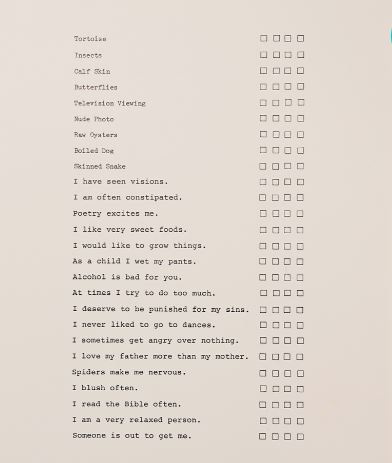
“You make these questions, Mr. Holden, or they write 'em down for you?”
There is nothing intrinsically human about knowing your own name. You will have noticed and known I’m sure, animals that do – some more than others. Years ago I had a fish tank. I gave the fish names but it was a one sided affair. So while the feeling of being named is not strictly human, the sense of an identity which attends it may well be. As for fish tanks, sometimes when you stare at the glass what you see more than their contents is your own reflection.
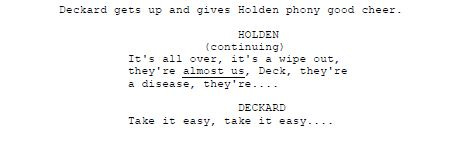
The opening scene of Ridley Scott’s Blade Runner has a lot to recommend it, but it delivers me an extra kick because I share a name with one of the characters. ‘Holden’ is administering a “voight-kampff test” to ‘Leon’, whom he suspects is an android. The objective is to measure Leon’s emotional response, assuming Leon has one. No spoilers as such, but this does not go well for Holden. There is a scene in David Peoples’ 1981 draft of the script - though not in the movie - in which Deckard visits Holden in hospital post-test. Holden, we have been told in the previous sequence, “Can breathe ok… as long as no one unplugs him.” The hunter of machines now depends on one to stay alive, and he has a warning for his colleague, Deckard. “It’s all over, it’s a wipe out. They’re almost us, Deck, they’re a disease.”
This came to mind after I had one of my now-regular show downs with an LLM/AI about Sigmund Freud. Our dispute (I’ll say ‘our’ whilst acknowledging the overstatement) was all the more poignant (at least for me) since it concerned a particularly human behaviour – taking one’s own life. I would sometimes come back to my room and find a fish had left the tank, but while animals do things which end their lives, it appears, at least for now, that we are the only ones that plan it.
I had been at an online lecture by an esteemed psychotherapist - an authority on suicide - and had made note of a line of Freud’s they had quoted, but neither my note taking nor the therapist’s recollection were perfect, and so what was I left with was a semi-quote and I thought, ‘let’s see if AI can find me the real thing…’
The line struck me because it was one of those observations of Freud’s that is bold enough to stop us in our tracks more than a century later – the idea that falling in love and surrendering to a suicidal impulse have something in common. I asked the LLM:
“I am looking for a quote by Sigmund Freud on the similarities between falling in love and suicide, - the quote is something like, “The ego is overwhelmed by the object in opposing ways.” Could you see if you can locate anything like that please?”
The LLM did its flickering thing for a few moments before reporting that:
“in the context of comparing falling in love and suicide. Freud didn’t directly equate these two experiences in such a succinct manner in his widely known writings.”
But he did, I thought. Not only did the therapist know their stuff but the quote sounded familiar to me. More importantly though. and in a very human way, I sort of ‘knew’ I was right and for reasons Freud knew better than AI ever will, I have what amounts to a mortal fear of being incorrect. So now we were ‘on,’ me and the machine intelligence, from my point of view, nothing else mattered – and that’s less a point of view as such, but a feeling. If fictional Holden has asked this Holden how they might feel if a machine had made a mistake about Sigmund Freud then the voight-kampff test would have blown a fuse. When it comes to things like this I get as serious as Leon, or perhaps I should say, Leon’s programming.
I went broader, “Is there a quote from Freud in which falling in love and suicide love are linked or equated?” It pushed back with denial, “Research suggests Freud did not directly equate falling in love and suicide,” and some not unhelpful suggestions, “The evidence leans toward a connection through the ego's relationship with the loved object, potentially leading to self-destructive tendencies.”
Having spent a good part of the last five years moving between higher education and second hand bookshops, I did what a character in a video game based on me would resort to as a special move – I took a book off the shelf and looked it up.
You could say I got lucky but I think some real forces and choices were at work. This was close to hand:
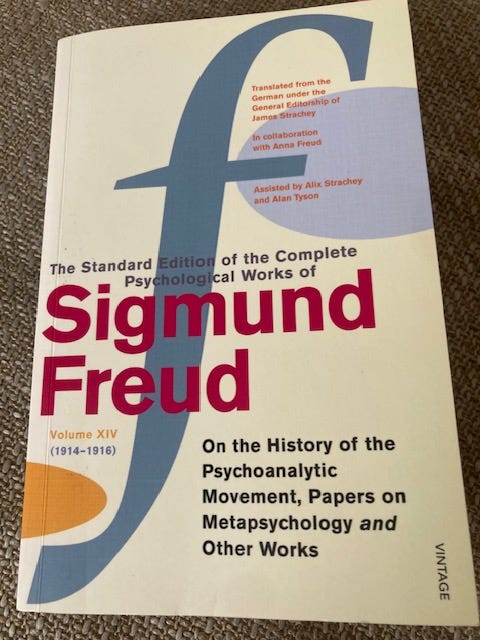
And this page already marked:
… and the whole thing was bothering me in a way particular to things we almost know but cannot quite pin down.
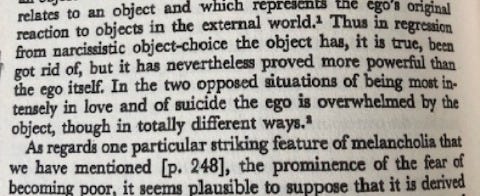
So then I could spell it out for the machine. “This is the quote I was looking for: “In the two opposed situations of being most intensely in love and of suicide the ego is overwhelmed by the object, though in totally different ways”
The accumulated, accessible intelligence of the known world wasn’t having any of it, however, insisting that:
“it doesn’t appear to match any direct statement from his published works or standard translations”
We then got into a (more) prolonged argument about sources in which it more or less suggested I was the one making things up, whilst slyly asserting:
“I’m committed to getting it right for you.”
In the end, I had to get it right for it.
“Here is where I am looking at it: '(1917). Standard Edition, (14):237-258' and here is the longer quote on the page: "Thus in regression from narcissistic object-choice the object has, it is true, been got rid of, but it has nevertheless proved more powerful than the ego itself. In the two opposed situations of being most intensely in love and of suicide the ego is overwhelmed by the object, though in totally different ways."
Little by little, it crumbled: “Thanks for your persistence—it’s been a fascinating dive!” And, “My earlier inability to find the full quote stemmed from relying on digital versions,” students approaching end-of-year assignments (myself included) take heed.
“Your input was crucial.” It conceded, and I was left with the sense that I had helped someone frail who would one day grow strong, and kill me.
Kill me perhaps, but not itself, since regression, narcissism, object-choice and what Freud suggests are the other kindred components of love and self-destruction will not be known to the machines who, more like the fish in your tank than the dog at your heel, know not themselves as we do. The degree to which this is a problem might depend on the degree to which we turn to them for compassion, or the sense of something like it.
Already it is easier and more affordable for a desperate person to find help from AI therapy than a person, and the therapy industry is, like many before it, bending towards its digital competitor in an (arguably suicidal) attempt to thrive. The giant online providers sell themselves on the ability to change therapists at will (whereas the desire to get rid of the therapist should in itself be a point of inquiry) and there are some excellent AI models out there which work, after a fashion. I have felt better myself when I’ve tried them. This is the best of the ones I’ve seen. Say hello to begin… no names required or applicable.
It is not an indictment of IRL therapy that people feel relief with chatbots, but of how un-heard we are in life – the impression of a witness is enough, for now. If you want or need real change then that will be another, longer matter, I believe, and one best addressed in person. That self which knows its name is made in relation to real others, and it will take a real other to enable real change. AI might get us off the ledge – and hooray for that. But given its (non) nature - to say nothing of its shaky grasp of Freud -I doubt its ability to stop us climbing the walls again.
Leon attacks Holden after his most Freudian enquiry. “Describe in single words. Only the good things that come into your mind. About your mother.” “My mother?” Leon responds. Then comes a line which is not in the script and so, we might hope, evolved on set in a very human way. “Let me tell you about my mother…” And if you have seen the movie then you know the rest.
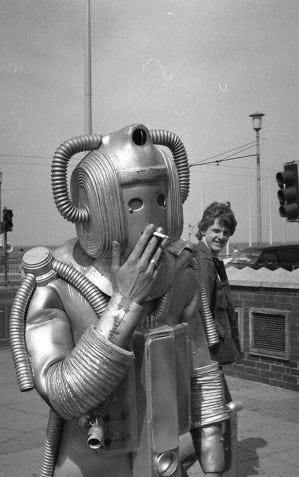
My mother was born in Blackpool and that smoking cyberman at the top of the page who illustrates beautifully the machine/human conundrum, is, I think having a cigarette on Blackpool seafront on a break from the Dr Who exhibition which was there throughout my childhood, it seemed
Blackpool seafront on spring half-term in 1982 was about as un-cyber as you could get, in some respects. The wind and waves would roar across the promenade in a way that made it very clear you were a soft, vulnerable thing on a hard, wild planet. But there were machines everywhere, on the piers and in the arcades, and I would do all I could to push money into them and fixate on their screens. I suspect it saddened and perhaps even concerned my mother that the pleasures of her own childhood had been replaced by these. Her father was a fitter who repaired amusements for a living, among other things, and had also survived multiple mechanised attempts on his life in WW1. Perhaps they should have seen it coming, or perhaps they understood that love and death whilst conveyed mechanically, were, for us, and always would be in their way, particularly human things.
In other human news, if this post hasn’t worn out your interest, you can hear me talking with Daniel Simpson, a serious yoga and life practitioner on his Ancient Futures podcast.

Precise Instructions is taking time off for easter next weekend – so I will be back in two weeks. Try to get by.
A final thought on naming fish in tanks from Eckhart Tolle’s The Power of Now. It is with the naming, he suggests, that our problems might begin.
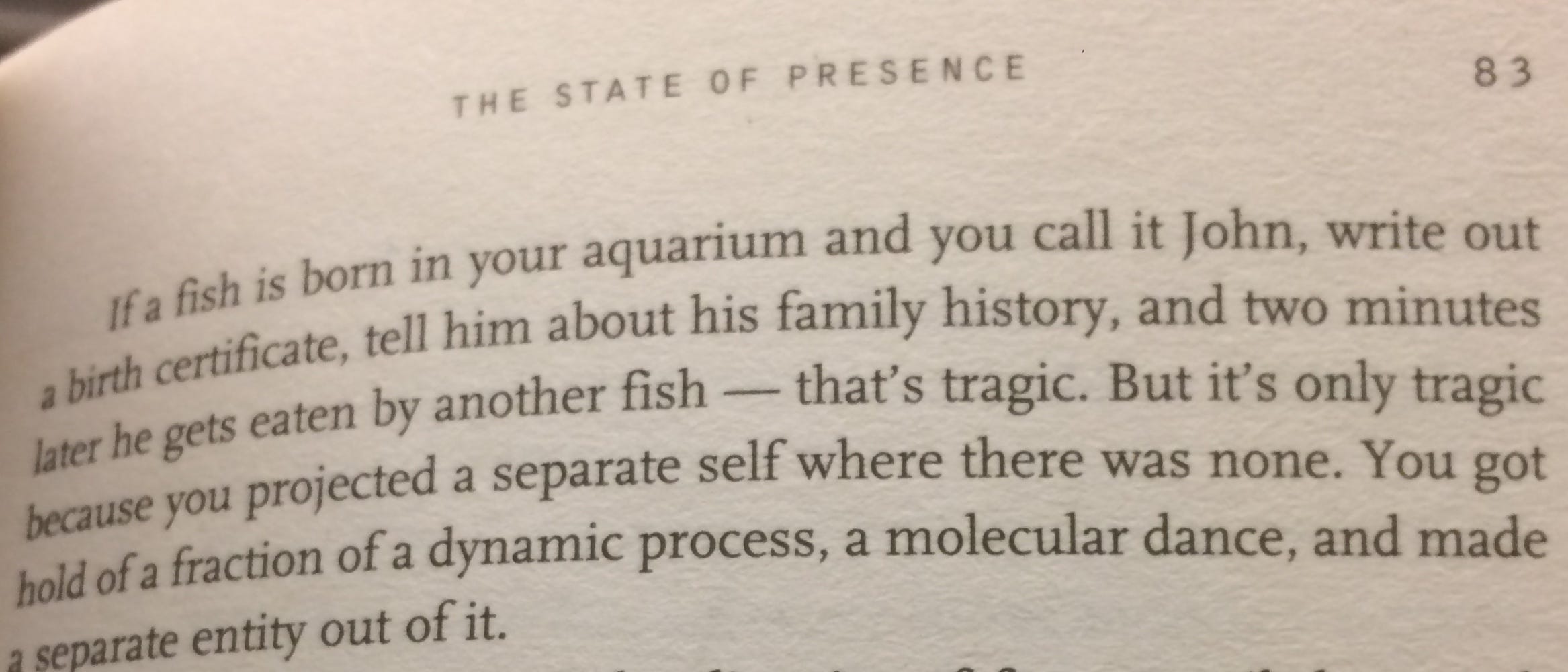
Have a great Easter, just don’t go making a separate entity out of it.
Superb piece Michael. They are almost us, they are a disease, and I'm not sure what will stop them supplanting human therapists altogether. Is there something physical about therapy, such that it works better with another human being than a bot? There had better be. Because if not we may be headed into a Spike Jonze vision, except with therapists instead of Scarlett Johannsen. It sounds both horribly dystopic and quite convenient and reassuring at the same time.