
(Don’t) Do the Hustle
On Losing Focus. The better to see.

Following someone on social media has never been a more strange arrangement. Since the innocent, early days of connectivity, each of us has been let down. You see something halfway interesting, funny or sane and pledge your continued attention thinking ‘don’t say anything unconscionable, now.’ Although that possibility is surely part of the attraction – the shadow of our loyalty being the thrill of taking it back.
I felt a minor tweak of this recently when someone I followed who seemed to offer useful advice in respect of creativity and determination came out with the following:
“Life is hard because you don't know what you want. That's 90% of the battle. Once you have extreme clarity on what you want, after 5-10 calculated risks, everything else is quite simple. If you can reach that before you turn 25, you're in the top 1%.”
No doubt at times I envy the clear, the focused and the knowing (and cannot say I had reached much that can be measured by the long-gone age of 25) but, by thunder, I am driven to produce – quite what or whether to remains a constant question. ‘Extreme’ clarity on what I want would be reserved for sleep, going home, someone else to be quiet, a decent sandwich, and so on. I know that I don’t know quite what I am up to, sometimes why, or whether it amounts to anything. Once this was wisdom, now it is reviled.
Forgetting Socrates line:
“Although I do not suppose that either of us knows anything really beautiful and good, I am better off than he is – for he knows nothing, and thinks he knows. I neither know nor think I know,”
… and cherry picking quotes from other noted minds, secure that the full text will not trouble their audience (search ‘Nietzsche’ on X for hours of this kind of fun) has become the remit of online motivational persuaders who seem determined to convince others that the aim of all transmissible wisdom is to swat the competition aside, whilst doing something with Bitcoin, probably.
The mutative power of neoliberalism is such that the ability to reimagine the experience of being into a kind of business plan, squid-gaming the spiritual, in effect, is such that these kinds of pronouncements (many of which have the whiff of A.I gruel) are an industry in themselves. And this instinct is not the preserve of the internet, this is culture-deep.
I was at a gathering of folks recently who, myself included, are in the latter stages of a postgraduate qualification. Our alma mater had decided that before setting us loose with our credentials we should meet those who came before us. I was struck by one former student who appeared to have about four jobs at once and referred to this as a “portfolio career.” That’s a new one, I thought. A bold cover story for a landscape where having a single role that can pay for you to eat and have children is long gone.
I walked home disconcerted by this latest twist in the lingua-psyche of late stage consumerism, and considered asking some of the people hustling among the pop-up tents between university and the tube station whether they thought of themselves as portfolio drug users. Safely outside the top 1% and perhaps even the obverse, they certainly appeared to have ‘extreme clarity’ in respect of what they wanted, if not where they would spend the night.
I have an old friend who has been in and out of prison more than once. He has had, on occasion, extreme clarity over what he wanted - only to find himself undone by the fact that it did not legally belong to him. He wouldn’t argue that life is hard because you don’t know what you want, but because you might. This was also the same person who introduced me to the work of M. Scott Peck, whose books he had read in prison and felt to be life-changing. Peck’s thinking might be distilled into an online sound bite as, ‘Life is hard.’ Not because you don’t know anything, but by its very nature. Here though is the actual opening of his rightly acclaimed, The Road Less Travelled:
“Life is difficult1. This is a great truth, one of the greatest truths[1]. It is a great truth because once we truly see this truth, we transcend it. Once we truly know that life is difficult – once we truly understand and accept it – then life is no longer difficult. Because once it is accepted, the fact that life is difficult no longer matters.”
Life is sometimes worse than difficult, of course, and unfair in most proportions. In my experience though, when people start to tell you ‘why’ this is so in your case, (including assertions about your lack of extreme clarity, focussed goals, and so on) they are trying to recruit you for something.
I was future proofed against extreme clarity early in life (aka ‘the battle’) by my brother bringing this album into the house in 1979.
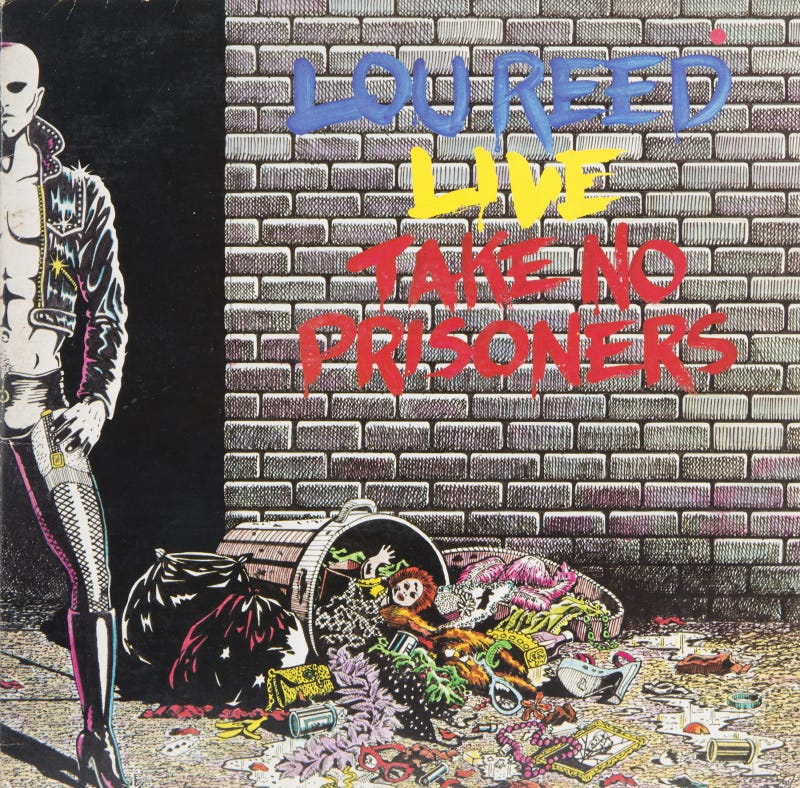
For a long time I could do no more than look at the sleeve. Then one day I put it on. It opens with ‘Sweet Jane’ but before that, whilst tuning up, Lou gets into it with a heckler, which yields the following:
[Lou]: I'm gonna quote a line like, like, from from Yeats
I think it is, like, for you
And that's called ‘the best lack all convictions
While the best are filled’ -
No, no it's the other way round
’The best lack all convictions
And the worst are filled with a passionate intensity’
Now you figure out where I am
You can hear it here:
Lou Reed was quoting Yeats’ ‘The Second Coming’ widely held to be about civilizational collapse. One sign of the apocalypse the poet did not foresee was the rise of online motivational quote-mongers. In case you are unclear - I am against this tide. We are approaching the fridge magnet at the end of the universe, I feel. I have extreme clarity in this regard. Self-helplessness. That’s me.
I am joking of course, like Fred Willard in Spinal Tap, but not entirely. It is the wisdom ‘to win’ aspect that concerns me - when it overrides the wisdom to help those you are beside.
For further wisdom on the perils of certainty, you might look here:

Peck gives a shout out to Buddha’s first noble truth at this point.
"Life is pain, highness. Anyone who says differently is selling something" - Wesley, as Dread Pirate Roberts in The Princess Bride